
Pool Chemical Levels Explained: What Every Florida Pool Owner Should Know
Harold Hatfield • May 2, 2026
Most Florida pool owners know their pool needs chemicals. What most do not know is what those chemicals actually do when you service your pool, what happens when levels drift out of range, and why getting it wrong costs real money. This article breaks down every key chemical in plain English, gives you the exact target ranges for Florida pools, and explains why chemistry in Florida is more demanding than almost anywhere else in the country and why so many pool owners has a
pool cleaning service. No lab degree required.
Why Pool Chemistry Matters More in Florida Than Anywhere Else
Florida's climate creates a perfect storm for pool chemistry imbalance.
Intense UV rays burn through chlorine in hours. Summer afternoon rain dumps acidic water directly into your pool, dragging down pH and diluting every chemical you just added. Heat speeds up every chemical reaction in the water. And because Florida pools run 365 days a year, there is no natural reset. The chemistry is always working, and always under pressure.
Florida's intense heat, relentless sun, and summer storms all create real challenges for pool water chemistry. On a hot, sunny afternoon, your pool can burn through its sanitizer in just a few hours.
Here is the problem most homeowners run into. They test one number, fix that one number, and call it done. But pool chemistry is not one number. It is five numbers that interact with each other constantly. When one drifts, the others are affected. Understanding how they work together is what separates a crystal clear pool from a cloudy or green one.
What Chemicals Does a Florida Pool Need?
Before getting into ranges and what happens when levels drift, here is the straightforward answer to what every Florida pool actually requires. A properly maintained Florida pool needs five chemicals managed on a regular basis:
- Chlorine to sanitize the water and kill bacteria and algae
- pH adjuster (muriatic acid to lower, soda ash to raise) to keep chlorine working at full strength
- Alkalinity increaser (sodium bicarbonate) to stabilize pH and prevent it from swinging after rain or heavy use
- Cyanuric acid to protect chlorine from being destroyed by Florida's UV rays
- Calcium hardness increaser (calcium chloride) to protect pool surfaces and equipment from corrosive water
Depending on your pool and water source, you may also use pool shock for periodic deep sanitizing, algaecide as a preventive during heavy algae season, and clarifier when water turns hazy from organic load.
This is not a complete list of chemistry, but it is the core, foundational 5, and if you get these right, your pool should be good!
The Five Chemical Levels Every Florida Pool Owner Must Know
1. Free Chlorine — Your Pool's Primary Defense
Chlorine is the front line of defense in your pool. It kills bacteria, destroys algae, and breaks down the organic waste that swimmers introduce every time they get in the water.
Target range: 2.0 to 4.0 ppm
In Florida, maintaining the lower end of that range is not enough during the summer months. According to the Florida Swimming Pool Association, a chlorine level in the 1.0 to 1.5 ppm range is often inadequate in Florida during the hot summer months. When temperatures consistently exceed 90 degrees, chlorine dissipates too quickly at that level. Targeting 2.0 to 4.0 ppm during peak summer gives your pool the buffer it needs. That's why we say 2.0-4,0 it's always hot in Florida.
Below 1.0 ppm, your pool is essentially unprotected. Algae can begin forming within 24 to 48 hours. Above 5.0 ppm, chlorine can irritate eyes and skin and is unnecessarily costly.
One important note: the number on your test kit is only meaningful in the context of your other chemical levels. Chlorine showing 2.0 ppm but operating in high-pH water may be working at only 10 to 20 percent efficiency. More on that below.
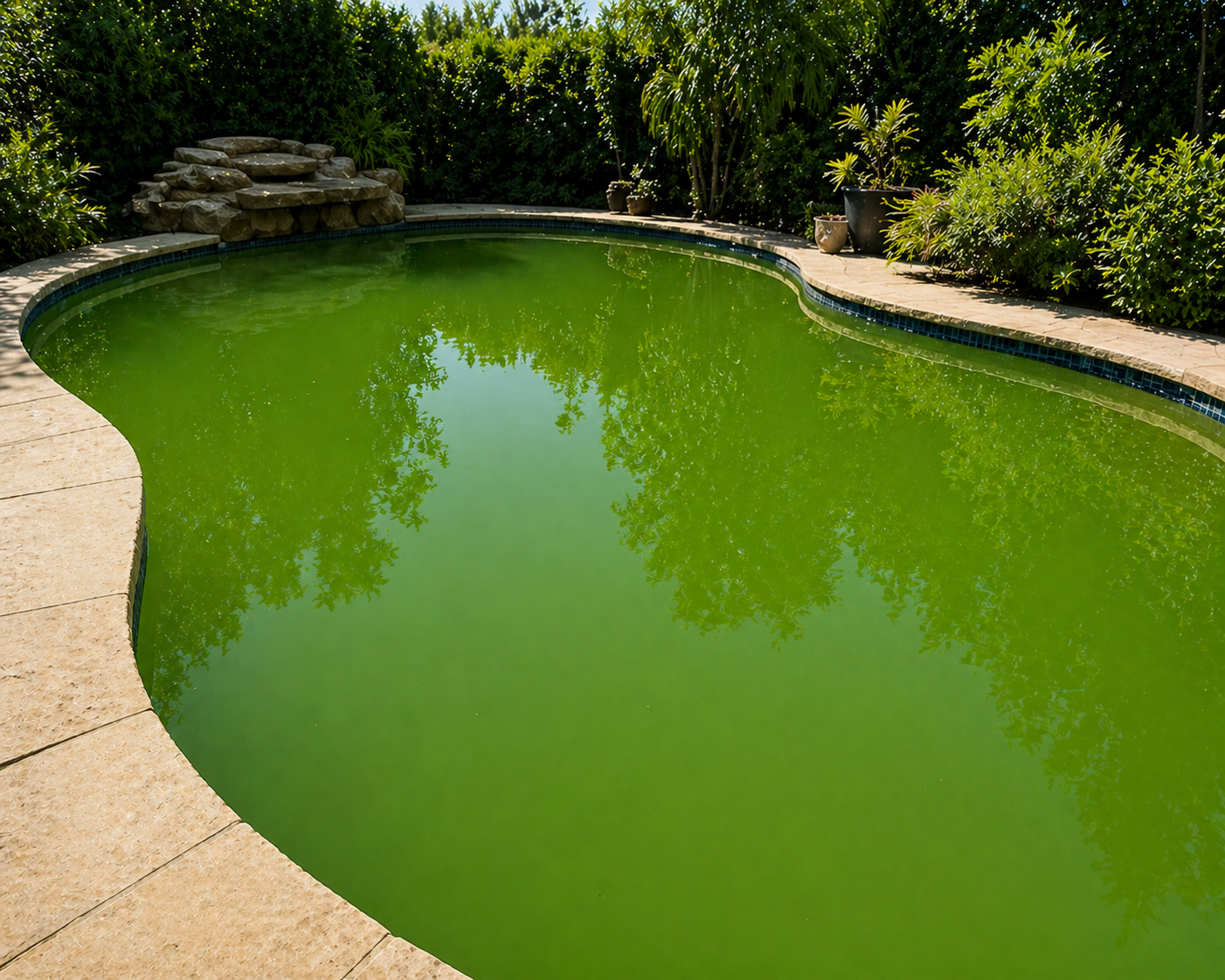
What happens when it is too low: Bacteria and algae take hold. Water turns cloudy, then green. An algae treatment or shock treatment becomes necessary, costing far more than the weekly service that would have prevented it.
What happens when it is too high: Eye and skin irritation. Bleaching of swimsuits. Unpleasant smell from the water. Unnecessary chemical expense.
2. pH — The Number That Controls Everything Else
pH is the most important number in your pool, and the one that affects every other chemical you add.
Target range: 7.4 to 7.6
The pH scale runs from 0 to 14. Pure water sits at 7.0. Below 7.0 is acidic. Above 7.0 is alkaline. Your pool needs to stay in a narrow window between 7.4 and 7.6 for two reasons: swimmer comfort and chlorine effectiveness.
Here is what most homeowners do not realize. High pH can form scale on the pool surface and in equipment, and make chlorine less effective. Low pH makes the water acidic and can erode your pool surface and equipment, as well as irritate swimmers' eyes and skin.
At pH 7.8, your chlorine is working at roughly 33 percent of its potential. At pH 8.0, it drops to around 20 percent. That means you could have a chlorine reading of 3.0 ppm and still have almost no real sanitizing power in the water.
Florida rain makes pH management especially challenging. Rainwater is slightly acidic, with a pH typically between 5.0 and 5.6. Even moderate rainfall can drag that number down fast, and a single heavy thunderstorm can undo a week's worth of careful chemistry maintenance.
What happens when pH is too low (below 7.2): Water becomes corrosive. It attacks pool surfaces, dissolves grout, corrodes metal fittings, and damages pool heaters. Swimmers experience eye burn and skin irritation.
What happens when pH is too high (above 7.8): Chlorine becomes largely ineffective. Scale builds up on tile lines, pool surfaces, and inside equipment. Water turns cloudy. Filters clog faster.
To lower pH, muriatic acid or dry acid is used in small, carefully measured doses. To raise pH, sodium carbonate (soda ash) is added. Always adjust alkalinity before pH. That brings us to the next number.
3. Total Alkalinity — The Buffer That Keeps pH Stable
Total alkalinity (TA) is closely related to pH but measures something different. While pH measures how acidic or alkaline the water is, alkalinity measures the water's ability to resist sudden changes in pH.
Target range: 80 to 120 ppm
Think of alkalinity as the shock absorber for your pH. When alkalinity is in the right range, your pH stays stable even after rain, heavy bather loads, or chemical additions. When it falls too low, pH can swing wildly from one day to the next. When it climbs too high, pH drifts upward consistently and becomes difficult to bring down.
Low total alkalinity leads to unstable pH levels. High alkalinity causes pH to drift upward more quickly, requiring frequent acid additions.
This is why professional pool technicians always adjust total alkalinity before making any pH adjustments. If TA is off, pH corrections will not hold.
What happens when alkalinity is too low: pH bounces unpredictably. You spend money on constant corrections. Chlorine effectiveness fluctuates. Surfaces can begin to etch.
What happens when alkalinity is too high: pH drifts upward constantly. Cloudy water develops. Scale forms on surfaces and inside equipment. Chlorine loses effectiveness.
4. Cyanuric Acid — Sunscreen for Your Chlorine
Cyanuric acid (CYA) is the chemical that makes outdoor pool chlorination in Florida actually work. Without it, Florida's sun would destroy most of your free chlorine within a few hours of direct exposure.
Target range: 30 to 50 ppm
UV radiation breaks down free chlorine at a rate that surprises most pool owners. On a bright Florida summer day, an unprotected outdoor pool can lose 90 percent of its chlorine in 2 to 3 hours of direct sun exposure. Cyanuric acid acts as a sunscreen for chlorine, dramatically slowing UV-induced degradation. Without it, Florida pool owners are essentially pouring money into the sky.
CYA does not evaporate from the water on its own. It accumulates over time and must be diluted through a partial drain and refill if it climbs too high. This is worth paying attention to because many chlorine tablets contain CYA, and using them exclusively over a long period can push levels well above 70 ppm.
Above 70 to 80 ppm, CYA begins to suppress chlorine's sanitizing power. This creates a situation where your chlorine reading looks fine but the water is not actually being sanitized effectively. Florida pool technicians call this chlorine lock.
What happens when CYA is too low: Chlorine burns off rapidly in the Florida sun. You constantly add chlorine but never hold a stable level. Operating costs climb and protection suffers.
What happens when CYA is too high: Chlorine becomes progressively less effective regardless of the reading on your test kit. Algae can bloom even when chlorine appears adequate. The only fix is to dilute the water through a partial drain and refill.
5. Calcium Hardness — Protecting Your Surfaces and Equipment
Calcium hardness measures the amount of dissolved calcium in the water. Florida's groundwater comes primarily from the Floridan Aquifer System, one of the most mineral-rich water sources in the country, which means Florida pool owners often start with naturally hard water.
Target range: 200 to 400 ppm
Water that is low in calcium hardness is aggressive. It will pull calcium from wherever it can find it, which in a pool means the plaster, grout, and concrete surfaces. Over time, low calcium hardness causes etching, pitting, and surface deterioration that is expensive to repair.
Water that is too high in calcium hardness causes the opposite problem. Excess calcium comes out of solution and deposits as scale on tile lines, in equipment, inside heaters, and on pool surfaces. In Florida's hard water environment, this is the more common direction for calcium to drift.
What happens when calcium is too low: The water essentially eats your pool. Plaster surfaces etch and roughen. Grout breaks down. Equipment corrodes faster. Resurfacing a pool costs thousands of dollars and is largely avoidable with proper chemistry.
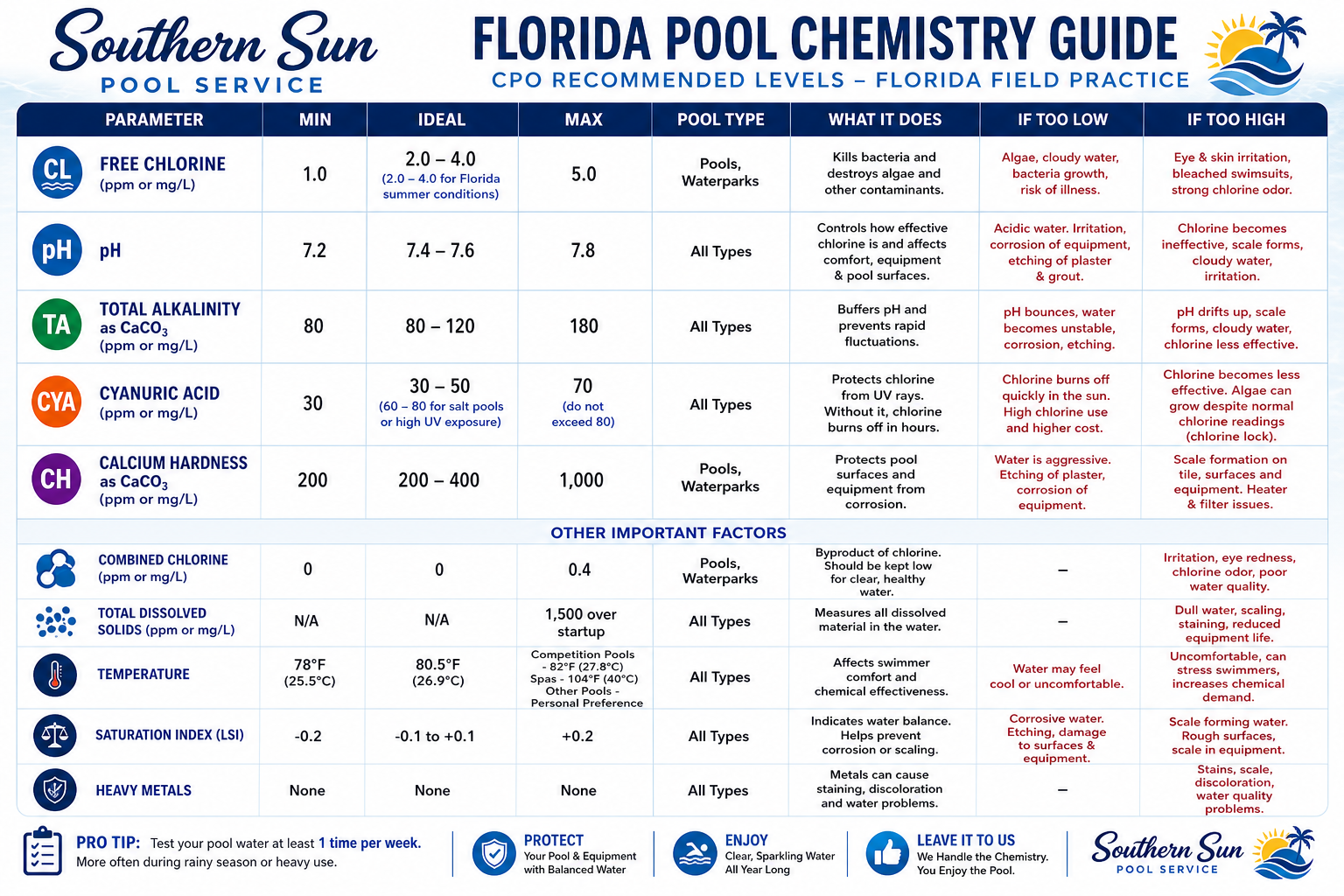
What happens when calcium is too high: White scale deposits form on tile lines, waterline surfaces, and inside equipment. Heater efficiency drops as scale builds up inside the heat exchanger. Filters clog more frequently. Here is a helpful chart:
How the Five Chemicals Work Together
Here is where most pool guides stop short. Understanding each chemical individually is not enough. They interact constantly, and a problem with one creates problems with the others.
A real scenario that Florida pool owners experience regularly: a homeowner adds chlorine to bring it up to 3.0 ppm. The water still turns cloudy a few days later. The problem is not chlorine. The pH has drifted to 7.9 from an afternoon rainstorm. At that pH, the chlorine is operating at a fraction of its capacity. The water is not being sanitized, and the cloudiness is the beginning of an algae issue.
This is why testing all five parameters, not just chlorine, is the professional pool service standard. One number tells you almost nothing. All five together tell you the full picture.
The order of adjustments matters too. Always address alkalinity first, then pH, then chlorine and stabilizer. Trying to fix pH before stabilizing alkalinity is like patching a leak while the water is still rushing in. The correction will not hold.
Pool Shocking: What It Is and When Florida Pools Need It
Pool shocking means adding a high dose of chlorine to the water to burn off built-up organic waste, chloramines (spent chlorine compounds), and to reset the sanitizing capacity of the water.
Florida pools should be shocked:
- After heavy bather use such as a pool party
- After any significant rainstorm
- When free chlorine drops below 1.0 ppm
- When water appears cloudy without a clear chemical cause
- As a regular part of ongoing maintenance, typically every two to four weeks during summer
One critical point for Florida pool owners: pool shock treatments should always be applied in the evening when temperatures are cooler for best results, maximizing the chemical contact time. High heat and intense UV radiation rapidly degrade chlorine, and attempting to shock a pool during the heat of the day significantly reduces the sanitizer's potency.
After shocking, do not swim until free chlorine returns to 2.0 to 4.0 ppm. Testing immediately after a shock treatment will produce a skewed reading. Wait at least several hours before testing again.
Saltwater Pools Still Require Chemical Management
A common misconception among Florida pool owners is that saltwater pools are chemical-free. They are not.
A saltwater system uses a salt chlorine generator to produce free chlorine from dissolved salt in the water. The sanitizer is still chlorine. The difference is how it is delivered — continuously generated on-site rather than added manually.
Salt water generators generate chlorine on-site, keeping levels steadier with less manual dosing, which is great in hot months. You will still need to balance pH, total alkalinity, and cyanuric acid, and you must control scale on the cell by keeping chemistry tight. It is a convenience and consistency upgrade, not a chemical-free system.
Saltwater pool owners still need weekly water testing. pH tends to drift upward in saltwater systems. Calcium hardness must be managed carefully to prevent scale buildup on the salt cell. All five parameters still apply.
How to Test Pool Chemicals the Right Way
Testing your pool water is not complicated, but doing it correctly makes a significant difference in the accuracy of your readings and the decisions you make based on them.
Step 1: Choose the right testing method
There are three common options for Florida pool owners:
Test strips are the most convenient but the least accurate. They give a rough snapshot of pH and chlorine and degrade quickly in Florida's heat and humidity. They are adequate for a quick mid-week check but should not be your primary testing method.
Liquid reagent test kits are the step up most serious pool owners use. They test all five parameters with high accuracy and do not lose reliability the way strips do. The Taylor K-2006 is the kit most pool professionals recommend for home use.
Digital photometer kits provide lab-level accuracy in a handheld device. They are what professional pool technicians use and eliminate the color-matching guesswork involved in liquid reagent kits. If you are managing your own pool chemistry in Florida, this is worth the investment.
Step 2: Collect your sample correctly
This step matters more than most people realize. Always collect your water sample from at least 18 inches below the surface, away from return jets, skimmers, and any point where chemicals were recently added. A surface sample skews chlorine readings. A sample near a return jet does not reflect the bulk water chemistry.
Use a clean sample container that has not been contaminated by previous chemical contact.
Step 3: Test in the right order
Always test in this sequence: total alkalinity first, then pH, then free chlorine, then cyanuric acid, then calcium hardness. This order matters because alkalinity affects pH, and pH affects how meaningful your chlorine reading actually is.
Step 4: Record your results
Write down your readings every time you test. A written log lets you spot trends before they become problems. If pH consistently drifts high every few days, that tells you something about your system or water source that a single reading never would.
Step 5: Make adjustments one at a time
Never add multiple chemicals to your pool at the same time. Add one, run the pump to circulate, wait the appropriate time, then test again before adding the next. This brings us directly to the next question Florida pool owners ask.
What Poor Pool Chemistry Costs Florida Homeowners
A common misconception among Florida pool owners is that saltwater pools are chemical-free. They are not.
A saltwater system uses a salt chlorine generator to produce free chlorine from dissolved salt in the water. The sanitizer is still chlorine. The difference is how it is delivered — continuously generated on-site rather than added manually.
Salt water generators generate chlorine on-site, keeping levels steadier with less manual dosing, which is great in hot months. You will still need to balance pH, total alkalinity, and cyanuric acid, and you must control scale on the cell by keeping chemistry tight. It is a convenience and consistency upgrade, not a chemical-free system.
Saltwater pool owners still need weekly water testing. pH tends to drift upward in saltwater systems. Calcium hardness must be managed carefully to prevent scale buildup on the salt cell. All five parameters still apply.
How Long to Wait Between Adding Pool Chemicals
This is one of the most practically misunderstood topics in pool care. Many guides suggest waiting 30 minutes to an hour between every chemical addition. The reality, according to Trouble Free Pool, one of the most respected pool chemistry resources available, is simpler than that.
The wait times between adding pool chemicals are usually around 10 minutes each, as that is also sufficient time for the chemicals to mix in the water. With the pump running on high and chemicals added slowly in front of a return jet, most chemicals distribute through the water faster than most homeowners expect.
That said, there are important exceptions every Florida pool owner needs to know.
The one hard rule: never add chlorine and acid at the same time or in the same spot.
The only chemicals you must never add at the same time are chlorine and acid. Add one, let the pump circulate for 10 minutes, then add the other to a different area of the pool.
Calcium hardness is the exception that requires real patience.
The only time you need to wait longer than an hour, with the pump running, is when adding calcium. You don't want to do anything that raises the pH for 24 hours after adding calcium. This means holding off on soda ash, baking soda, and liquid chlorine for a full day after a calcium addition. The reason is that combining calcium with pH increases causes calcium clouding, where calcium particles temporarily precipitate out of solution and turn the water hazy or leave deposits on surfaces.
For alkalinity adjustments, watch the effect on pH before adding anything else.
Some chemicals, like those used to raise total alkalinity, affect multiple things and you would want to wait and see the effect on pH before adding acid. Baking soda raises alkalinity but can nudge pH upward as well. Give it 30 minutes to circulate before deciding whether a pH adjustment is needed.
For CYA and salt, wait 24 hours before retesting.
The only ones that you need to wait 24 hours before retesting are CYA and salt. Both dissolve slowly and distribute unevenly in the short term. A reading taken too soon after adding either one will not reflect the actual level in the water.
The practical takeaway for Florida pool owners: 10 minutes of circulation between most additions is enough. Never combine chlorine and acid. Wait a full day after calcium before adding anything that raises pH. And do not retest CYA or salt until the next day.
What Poor Pool Chemistry Costs Florida Homeowners
Bad chemistry is not just a water quality issue. It is a financial issue. This is why proper pool cleaning and chemistry management is so important.
Here is what drifting chemistry actually costs over time:
Algae treatment and green pool recovery runs $250 to $1,000 or more depending on severity. A single bloom that develops from low chlorine and high pH can require multiple shock treatments, acid washing, or in severe cases a full drain, acid wash, and refill.
Surface damage from low pH or low calcium hardness leads to etching, pitting, and erosion of plaster finishes. Resurfacing a pool costs $3,500 to $10,000 or more. Much of this damage is caused by chronically unbalanced chemistry over months or years.
Scale damage from high calcium or high pH coats heater elements, clogs filters, and builds up on tile and surfaces. Descaling and equipment repair adds up quickly.
Equipment failure from corrosive water shortens the life of pumps, heaters, and filters. A pool heater alone costs $1,500 to $3,500 to replace.
Consistent, correctly balanced chemistry does not just keep the water clear. It protects tens of thousands of dollars in pool infrastructure from preventable deterioration.
What Every Florida Pool Owner Should Take Away
Florida pool chemistry is more demanding than most guides acknowledge. Five parameters interact constantly, UV rays burn through chlorine faster than anywhere up north, and rain disrupts balance on a weekly basis from June through September.
The key points to remember:
Chlorine does not work properly without the right pH. pH does not stay stable without proper alkalinity. Chlorine disappears in hours without cyanuric acid. And calcium hardness protects every surface your water touches.
Getting all five right, consistently, every week, is what separates a pool that costs money to fix from one that just costs money to enjoy.
If keeping up with five interacting chemical parameters every week sounds like more than you signed up for when you got a pool — that is a completely reasonable conclusion. Most Florida pool owners feel the same way.
That is exactly what Southern Sun Pool Service is here for. We test all five parameters on every single visit, make precise adjustments, and keep your water balanced and swim-ready all year long.
You enjoy the pool. We handle the chemistry.
Need help? We cover the following areas:
Learn More
About Southern Sun Pool Service
Southern Sun Pool Service is a locally owned Florida pool cleaning company specializing in weekly pool maintenance, chemical balancing, and equipment care. We keep Florida pools crystal clear all year long.